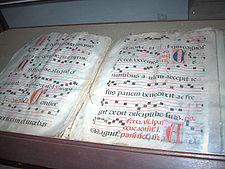
The Latin hymn Urbs beata Ierusalem is by consensus cosidered a seventh century hymn - give or take - for the dedication of a church. It's earliest extant version appears in a ninth century manuscript. The first four verses usually sung at vespers or matins, with the second half, Angularis fundamentum plus a doxology was sung at lauds. Translated by John Mason Neale in Mediæval Hymns and Sequences (1851), the modern day Christ is made the sure foundation is derived from this half, verses five through nine of the full original.
The tune is excerpted from the concluding Alleluias of the anthem, O God, thou art my God (Z 35)* by Henry Purcell (1659-1695), and was named WESTMINSTER ABBEY by Sydney Hugh Nicholson, the Abbey's organist from 1919-1928 as homage to Purcell, who once held the post. The tune was adapted in 1843 by a canon of Westminster Abbey, Ernest Hawkins, and the initial appearance bore the name BELLEVILLE. It was nearly a century before it emerged as WESTMINSTER ABBEY in the Shortened Music Edition of Hymns Ancient and Modern (1939), followed by the popular full version of HA&M (1950).
The union of this text and tune were not cemented until the 1960 royal wedding of Princess Margaret and Antony Armstrong-Jones, the first televised royal wedding of English royals. Until that time, the favored tune was REGENT SQUARE.
A different translation of Angularis fundamentum is "Christ is our cornerstone" by John Chandler, set to CROFT'S 136th.
* not to be confused with O Lord, thou art my God Z 41, a frequent misattribution.
1. unison
Christ is made the sure foundation,
Christ the head and cornerstone.
Chosen of the Lord and precious,
Binding all the church in one;
Holy Zion’s help forever,
And her confidence alone.
4. descant
Laud and honor to the Father,
Laud and honor to the Son,
Laud and honor to the Spirit
who from both with both is One:
One in might and one in glory
while unending ages run.
Further reading
Glover, Raymond F., Hymnal 1982 Companion, New York : Church Hymnal Corp., 1990, vol 3b, pp 971-973
Mediæval Hymns and Sequences/Urbs beata Jerusalem (1867), John Mason Neale (via Wikisource)
Christ is made the sure foundation – Westminster Abbey, Hyperion Records.
Angularis fundamentum, from the blog Saint Augustine's Lyre
Christ Is Made the Sure Foundation: Meaning, History, and Theology, HymnInfo
O God, thou art my God Z 35 (Youtube at timecode)
Descant verse
Laud and honor to the Father,
Laud and honor to the Son,
Laud and honor to the Spirit
who from both with both is One:
One in might and one in glory
while unending ages run.
-Angularis fundamentum, c.7th C. tr. John Mason Neale