Demo of the hymn tune COELITES PLAUDANT with a cappella verse and harmonized descant. Free score.
1 unison
Christ the fair glory of the holy angels,
maker of all things, ruler of all nature,
grant of thy mercy unto us they servants
steps up to heaven.
5 satb adapt. from RVW
May the blest mother of our Lord and Savior,
may the celestial company of angels,
may the assembly of the saints in heaven
help us to praise thee.
6 descant
Father almighty, Son, and Holy Spirit,
God ever blesséd, hear our thankful praises;
thine is the glory which from all creation
ever ascendeth
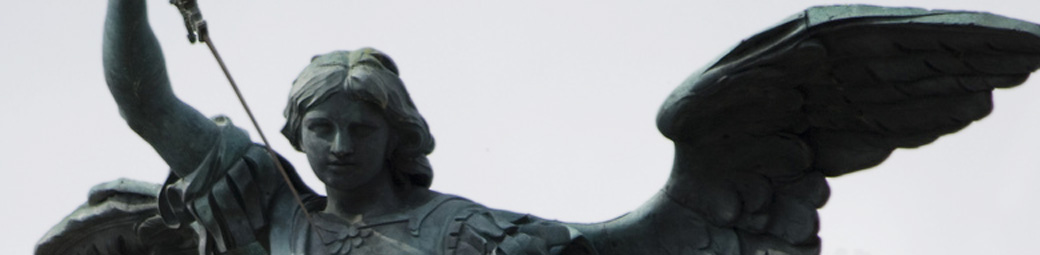
The text 'Christ, the fair glory of the holy angels,' is a translation of a 9th C. office hymn, Christe sanctorum decus angelorum, and is now in wide use for the Feast of St Michael and All Angels. This hymn cites celestial visitors who have graced this earth, and once again calls on them to renew their graces: Christ the Savior, three archangels (Michael, defender; Gabriel, herald; Raphael, healer), Mary, the saints, and all the company of angels. The hymn concludes with a doxology. The hymn, only extant in manuscripts dated 11th C. and later, is usually attributed to Rabanus Maurus, who is also sometimes cited as the author of Veni creator spiritus. The difficulty with these attributions is that Rabanus, an important scholar of his day - and considered the founder of German education - was known for his encyclopedic output and for versification of existing work, but not original verse. Nineteenth century German scholars of Latin poetry discounted this attribution entirely.
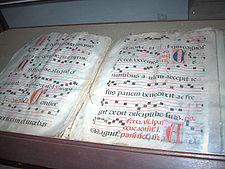
A French tune from the 1728 Rouen Antiphoner, it emerged in the 1906 hymnal with a new harmonization by Ralph Vaughan Williams as COELITES PLAUDANT, 'the heavens praise'. Combined with the hymn Christ the fair glory, the result is a majestic setting that is today a fixture for Michaelmas. The hymn is in the peculiar Greek poetic form known as Sapphic meter (11.11.11.5), named for the Greek poet who used this verse form for a significant portion of her work.
The Latin version of this hymn is also sung to another French tune from the same period, Christe sanctorum, which takes it's name from the Latin text of "Christ the fair glory," and which tune is given the honor of being hymn 1 in The Hymnal 1982.
P.S. - The Hymnal 1982 uses an alternate name. Caelites plaudant, 'the heavenly ones praise'; but as given by the English Hymnal, the arrangement's original publisher, the tune name is Coelites plaudant, 'the heavens praise.'
January 2015
References
Julian, John. "Hrabanus (Rabanus) Maurus". A Dictionary of Hymnology, Revised Edition with Supplement, London:John Murray, 1915, Appendix 1 p1531 via Internet Archive
"Blessed Maurus Magnentius Rabanus." The Catholic Encyclopedia. Vol. 12. New York: Robert Appleton Company, 1911. New Advent (website)
Britannica, Rabanus Maurus, https://www.britannica.com/biography/Rabanus-Maurus
Version 9.4.1
Free organ score with harmonized descant (and an a cappella SATB harmonization adapted from RVW)
Verse 6
Father Almighty, Son, and Holy Spirit,
God ever blessed, hear our thankful praises;
Thine is the glory, which from all creation
ever ascendeth.