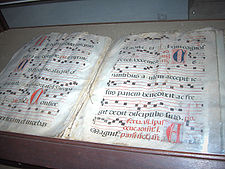
An office hymn for Lauds of Advent, Vox clara ecce intonat is drawn from a document inscribed in the 10th century, the earliest cited copy; it is thought (or said) by some scholars to date to the 6th or even 5th century but there is no primary source evidence of this. The vox clara, the clear voice, is John the Baptizer: "make straight in the desert a highway for our God." Our current version is from a 1632 version in the Roman breviary, which added the doxology, and was translated for Lyra Catholica (1849) by Edward Caswall, and later in Hymns Ancient and Modern (1861).
The music editor of this hymnal was William Monk, who composed the tune for The Parish Choir (1850), and more famously for Hymns Ancient and Modern (1861), for which he was music editor. Since that date, MERTON has been inetricably linked to 'Hark! A thrilling voice is calling.)
1. Mionk harmonization
Hark! A thrilling voice is sounding,
"Christ is nigh" it seems to say.
Cast away the works of darkness
O ye children of the day.
4. descant
Honor, glory, might, and blessing
to the Father, and the Son,
with the everlasting Spirit
while unending ages run.
Further reading
Glover, Raymond F., Hymnal 1982 Companion, New York : Church Hymnal Corp., 1990, vol 3a, #59, pp 112-113
Hark! A thrilling voice is sounding (1867), St. George's Cathedral, Kingston ON
Descant verse (key: E)
Honor, glory, might, and blessing,
To the Father, and the Son,
With the everlasting Spirit
While unending ages run.
-Vox clara ecce intonat, c. 10th C. tr. Edward Caswall