Audio Playlist
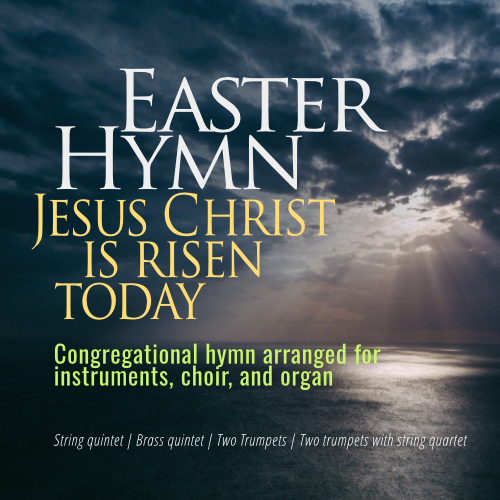
Jesus Christ is risen today
Score and parts instrumental arrangements: Strings (Quintet or Ensemble), 5-part brass ensemble and timpani with full descant, or two trumpets / two trumpets and strings with cadential descant. Score in concert pitch, trumpet parts in both B♭ transposition and C. Important revision to brass quintet Jan 2026; previous buyers can log in to download the updated package at no cost.


Easter Hymn (Two Trumpets and String Quartet)
Two Trumpets and String Quartet
Score and parts
New 2026

Description
Jesus Christ is risen today
The tune EASTER HYMN was first published in the 1708 volume, Lyra Davidica, with the title The Resurrection. The composer is unknown. The older of the two English texts commonly sung to this tune, 'Jesus Christ is risen today,' is based on a 14th C. Latin hymn found in a manuscript from Munich, Surrexit Christus hodie, the English translation hewing closely to the original. A later manuscript from Breslau includes a verse - Mulieres o tremulae - alluding to the first witnesses, the women who came to the tomb:
Haste ye women from your fright
take to Galiliee your flight.
To the sad disciples say
Jesus Christ is risen today.
Unlike the staid metrical psalm settings predominating English hymnody, EASTER HYMN incorporates more variety, with melismatic Alleluias assigned to the congregation. The tune is English in origin, appearing first in tune-and-bass score only, which would not be unusual in the figured bass era, and later as a faburden (tune in the tenor). It was immediately popular, and other musical adaptations were common until it took its final form in Hymns Ancient & Modern (1861). The first English translation appeared together with the tune, and underwent several modifications, concluding with the additon of a doxology in 1882. Charles Wesley wrote the the text 'Christ the Lord is risen today' in 1739 in A Collection of Tunes, Set to Music, As They Are Commonly Sung at the Foundery, an abandoned facility that was the home of London's first Wesleyan congregation, the prosody more consonant with the pietistic sensibilities of the time, less didactic than its ancient forbear. Because the number of verses and the prosody for the Wesley text is so varied, we will set your preferred text in this arrangement and set a separate link for you when complete (less than forty-eight hours).
References
Glory to God: A Companion, Carl P. Daw Jr. (Louisville, Kentucky : Westminster John Knox Press, 2016)
Lyra Davidica (1708), Archive.org, p.11
An Annotated History of Hymns, J.R. Watson, ed. (Oxford University Press, 2002)
Editions
Current Versions / March 2026
- added additional new intrumental configurations
- String Quintet, Organ, and Choir (score: US LGL portrait)
- Two Trumpets, Organ, and Choir (score: US LTR landscape)
- Two Trumpets, String Quartet, Organ, and Choir (score: US LGL portrait)
- original brass re-engraved
- Easy page turns (score: now US LTR landscape)
- Major revision upper three brass parts, especially horn (update highly recommended)
- Notation stylesheet updated
- added cues and specific dynamics
Previous Versions
Version 16.17.3 / Sep 2023
- Revised three bars in descant / organ (v 3)
Version 16.16.3
- Revised verse 4 brass & organ (refined a congregational cue)
- Shared trumpet and trombone split to exploded staves
Version 16.15.9
- Revised verse 4 brass (improve congregational cues)
- New house score style
16.15.8
- Revised Prologue
- Revised Bridge
- Revised Brass v.4
16.15.3
- Revised Prologue - first seven measures (previously 10)
16.3.3.3
Change to organ in bridge meas. 69-71 (match audio ad lib)
16.3.2
- Voice leading improvements, all instrumental parts
- Changes to Timpani part
- Tuning cues added to Timpani part
16.3.2.2
- Missing measure repaired
- Copyist error corrected
Verses
1 Jesus Christ is ris'n today, Alleluia!
our triumphant holy day, Alleluia!
who did once upon the cross Alleluia!
suffer to redeem our loss. Alleluia!
2 Hymns of praise then let us sing Alleluia!
unto Christ our heav'nly King, Alleluia!
who endured the cross and grave, Alleluia!
sinners to redeem and save. Alleluia!
3 But the pains which he endured, Alleluia!
our salvation have procured; Alleluia!
now above the sky he's King, Alleluia!
where the angels ever sing. Alleluia!
4 Sing we to our God above Alleluia!
praise eternal as his love; Alleluia!
praise him, all ye heav'nly host, Alleluia!
Father, Son, and Holy Ghost. Alleluia!
Surrexit Christus hodie, c. 1000; tr. Jane Eliza Leeson (alt)
Binding

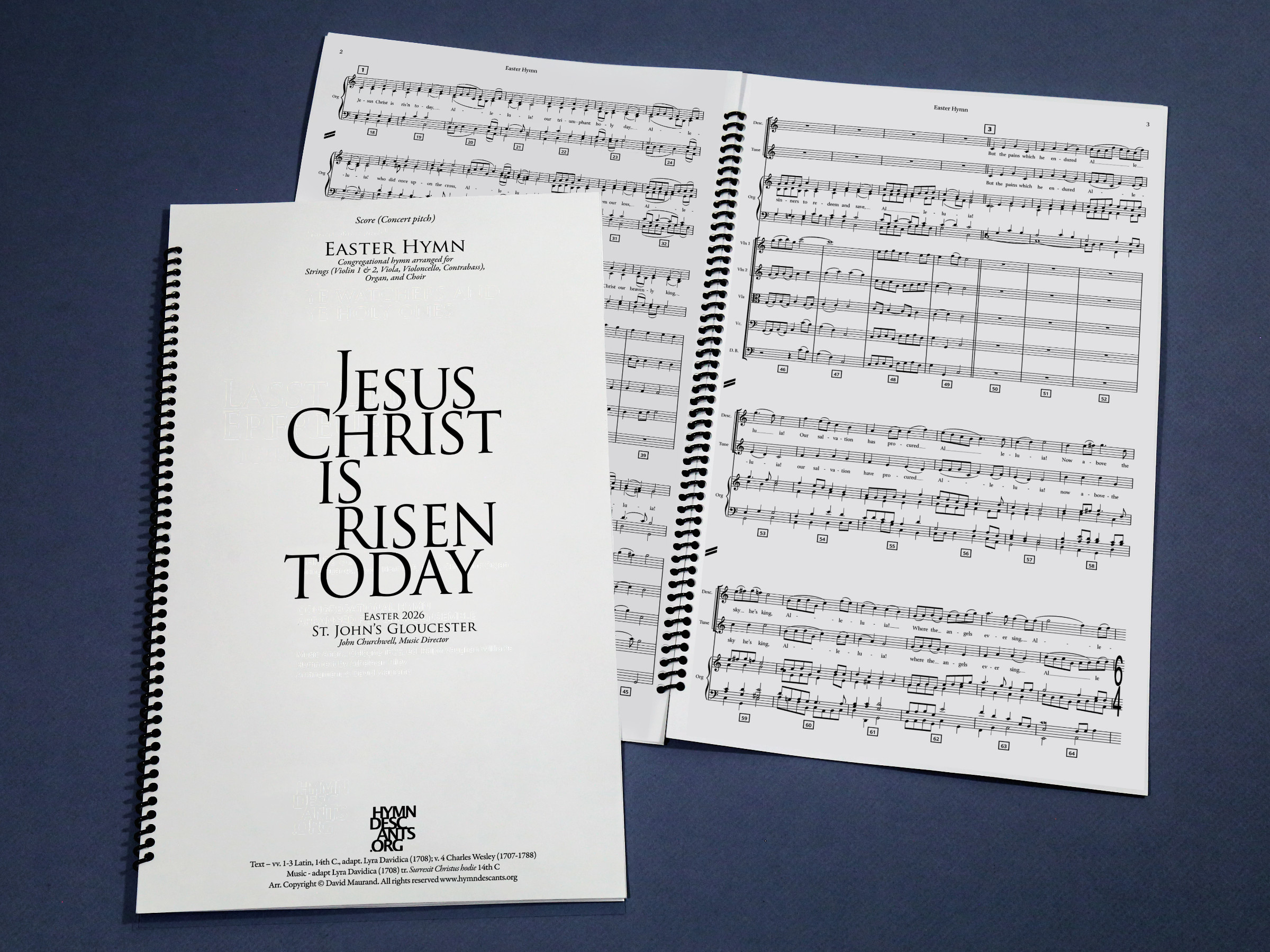
Both scores have been formatted to US Letter, landscape orientation cover plus 13pp and 6pp, respectively. This more compact size allows for use from the organ bench, as well as by a conductor. (nevertheless, there is a separate, shorter organ part.) The treatment shown in the image can be produced by uploading the pdf to Staples or your regular quick printer - which should cost less than $10 in 2025.
Video (w/ score)
Five Easter Pieces
For Brass Quintet and Timp
or Two Trumpets
with congregation, choir, and organ.