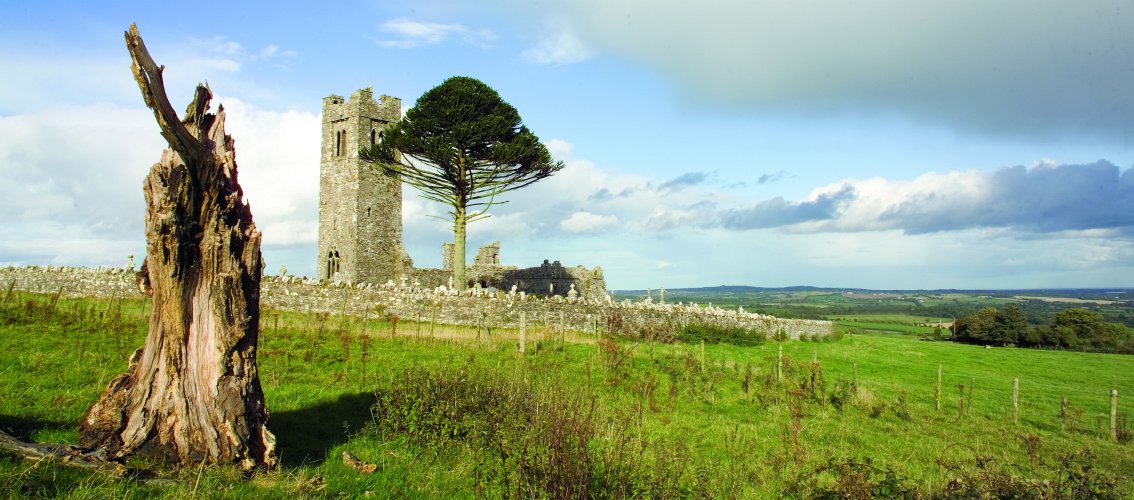
Audio: 'Be thou my vision.' (1) harm. David Evans (1874-1948) | (2) Hymnal 1982 (adapt.) | (organ ad lib) | (3) Descant -- Image: Hill of Slane, from Discover Boyne Valley. The ruins are of a 16th C. Franciscan community built atop the earlier abbey.Free score.
1 unison
Be thou my vision, O Lord of my heart;
all else be nought to me, save that thou art—
thou my best thought, by day or by night,
waking or sleeping, thy presence my light.
2. study: duet
Be thou my wisdom, and thou my true word;
I ever with thee and thou with me, Lord;
thou my great Father; thine own may I be;
thou in me dwelling, and I one with thee.
3 descant
High King of heaven, when victory is won,
may I reach heaven's joys, bright heaven's Sun!
Heart of my heart, whatever befall,
still be my vision, O Ruler of all.
Slane is near the ancient hill of Tara, in Ireland, a revered sacred site that dates back to the island's pre-Christian (and pre-Celtic) past. But forget all that. The tune now bearing the name SLANE has nothing at all to do with Slane's sacred hill; it is an anonymous 'trad' tune – a direct descendant of 'With my love on the road,' with lineage that includes variants such as this one and this one (video). The folk tune was first published (without annotation or attribution) by Patrick Joyce in Old Irish Folk Music and Songs in 1909; the tune was adapted closely by Leopold Dix and renamed SLANE for the 1919 Irish Church Hymnal. The current form derives from David Evans' adaptation for the 1927 Church Hymnary.
The hymn 'Be thou my vision' is from a very early 8th century Irish text, Rop tú mo Baile, consisting of sixteen verses with the incipit 'Be thou...,' a reiterative prayer for protection known as a Lorica (cf. ST PATRICK'S BREASTPLATE, 'I bind...'). Though sometimes attributed to Dallan Forgaill, a 6th C. bard of particular note, most scholars prefer the later date and unknown authorship. The hymn remained in the Irish monastic tradition for centuries before it became associated with the folk tune we now call SLANE. The literal 1905 English translation by Mary E. Byrne, M.A., appeared in Ériu (the journal of the School of Irish Learning), and the most commonly used metrical version was introduced in 1912 by Eleanor H. Hull. 'Lord of all hopefulness' was written by Jan Struther, the pen name of poet and writer Joyce Anstruther (1901-53). She was the creator of the character Mrs. Miniver, featured originally in newspaper columns and eventually collected into the famous book (1939). The hymn was commissioned in 1929 by Pearcy Dearmer, one time editor for the landmark 1906 English Hymnal, who was at the time Struther's neighbor as well as dean of Westminster Abbey. It was published in Dearmer's Songs of Praise (1931); the poet herself chose the tune.
For Ann F. Droppers, 2013
Updated: Nov 2020
More information
Glory to God: A Companion - Carl P. Daw, Westminster John Knox Press, 2016
Christianity Today - 16 verses (tr. Mary Byrne, 1905)
History of Hymns - C. Michael Hawn, UMC Discipleship Ministries
Old Irish Folk Tunes - Patrick Joyce, 1909, p. 151 (#323)
British Library - traditional performance of the original (audio clip, 0:00 to 1:14)
Be thou my vision - David Russell Hamrick (excellent commentary)
An Introduction to Celtic Sprituality - Patrick Comerford
Lord of all hopefulness - Rupert Christiansen, The Telegraph
Rop tú mo baile - Anglandicus
Be thou my vision
Lord of all hopefulness
Descant verse (Be thou my vision):
High King of heaven, when victory is won,
may I reach heaven's joys, bright heaven's Sun!
Heart of my heart, whatever befall,
still be my Vision, O Ruler of all.
– Irish, 8th C., tr. Mary Elizabeth Byrne, 1905