DEMO: 1 - hymnal verse harm. Mary Bridges | 2 - original Haydn a cappella STB trio | 3 - harmonized descant. Free score.
1 unison (hymnal harm. Mary Bridges)
O Trinity of blessed light,
O Unity of princely might,
the fiery sun now goes his way;
shed thou within our hearts thy ray.
2. sab (orig Franz Josef Haydn)
To thee our morning song of praise,
to thee our evening prayer we raise;
O grant us with thy saints on high
to praise thee through eternity.
3 descant
To God the Father, heavenly Light,
to Christ revealed in earthly night,
to God the Holy Ghost we raise
our equal and unceasing praise.
The text 'O blest Creator' is translated from the 6th century hymn, Lucis Creator optime, which is attributed to Gregory the Great, and set in the Ambrosian rhythm, iambic tetrameter. Its use was for the evening office of vespers (evensong) during seasons we associate with 'green' liturgical appointments - days after Pentecost and Epiphany. The vesper hymn 'O Trinity of blessed light' is an ancient text, O lux beata Trinitas, often credited to St Ambrose in the 4th C., though scholars are dubious of this attribution. The most common monastic use was for vespers (evensong) for Saturdays and Trinity Sunday. The current English text is translation layered upon translation, and the third verse doxology was acquired in the 18th C, of which there are several variants.
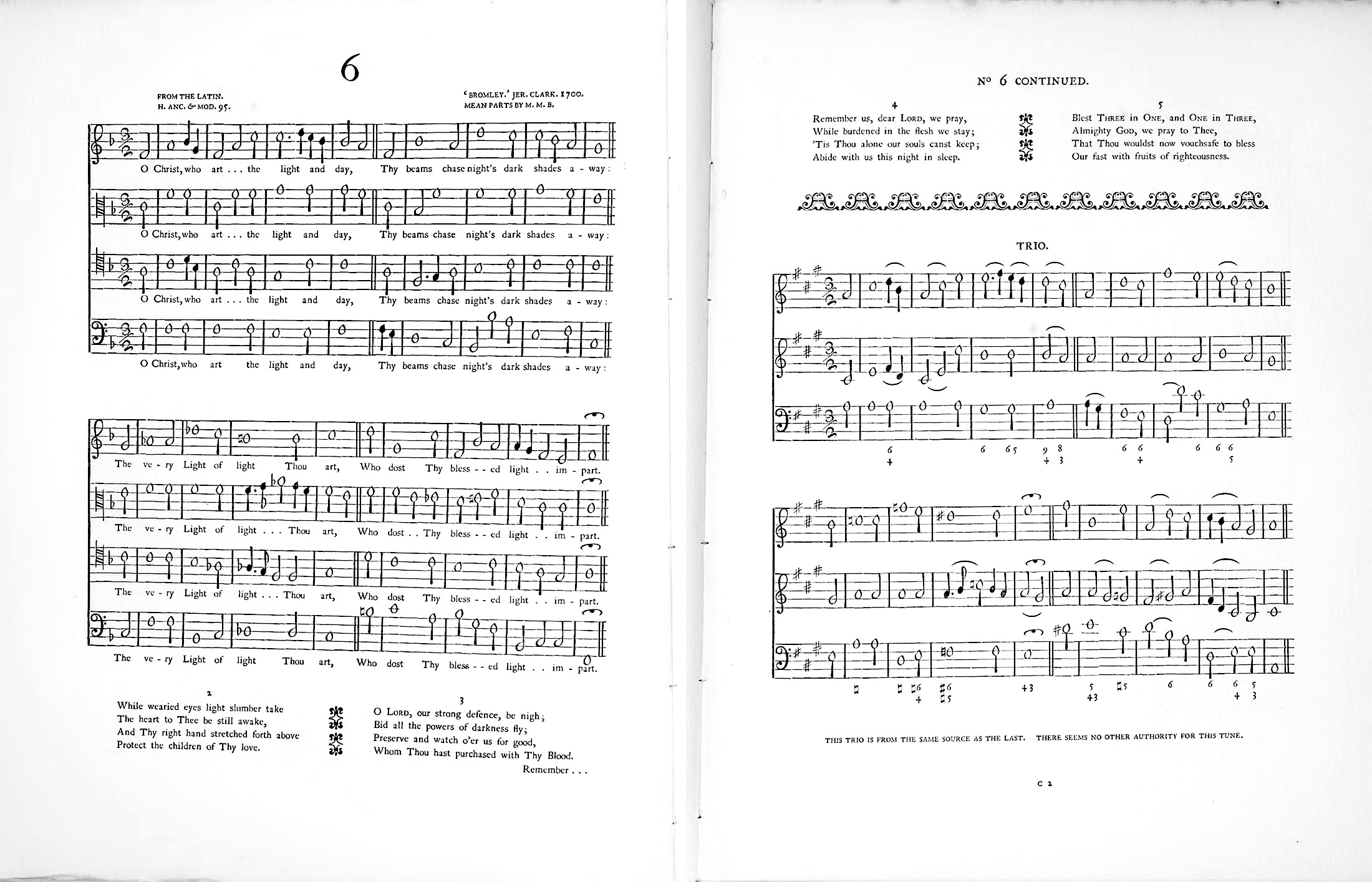
The tune BROMLEY is usually credited to Jeremiah Clarke (1674-1707) but the first published use of the tune and setting was Franz Josef Haydn's "O let me in th'accepted hour," a metrical setting from verses of Psalm 69 which appeared in Improved Psalmody (1794) along with five other settings. Fifteen years later, Haydn's setting appeared in a different collection, misattributed to Clarke. The editor of the erroneous compilation (Wiliam Russell, 1809) is known to have quoted Haydn in his own work, and numerous indexes of the day cite his authorship of Six anthems adapted from the works of Haydn, etc., dated just one year after Improved Psalmody. The misattribution to Clarke is ironic, given that he has been victimized by two notorious misattributions: he is the true composer of two compositions wrongfully ascribed to Henry Purcell: The Prince of Denmark's March (aka, the 'Trumpet Voluntary'), and Trumpet Tune in D, which is actually an organ piece for a trumpet stop. The tune name BROMLEY memorializes a town near London, and the four-part voicing was arranged for the 1920 Yattendon Hymnal by Mary Bridges, including the 1809 trio from Russell, and misattribution to Clarke.
Sources
Haydn Seek, "1794 – The Year part 5 – Sightseeing, Talking & Making Music"
The Hymnal 1982 Companion (Raymond Glover, ed., New York: The Church Hymnal Corporation, Vol 3, pp. 28-29)
The Music Times (London: Novello, London, 1909, pp. 773 ff)
Set includes organ score and separate descant parts for two texts, O blest Creator and O Trinity of blessed light.
Doxology , O Trinity of blessed light–
To God the Father, heavenly Light,
To Christ revealed in earthly night,
To God the Holy Ghost we raise
our equal and unceasing praise;
–Charles Coffin, 1736
Updated March 2021